
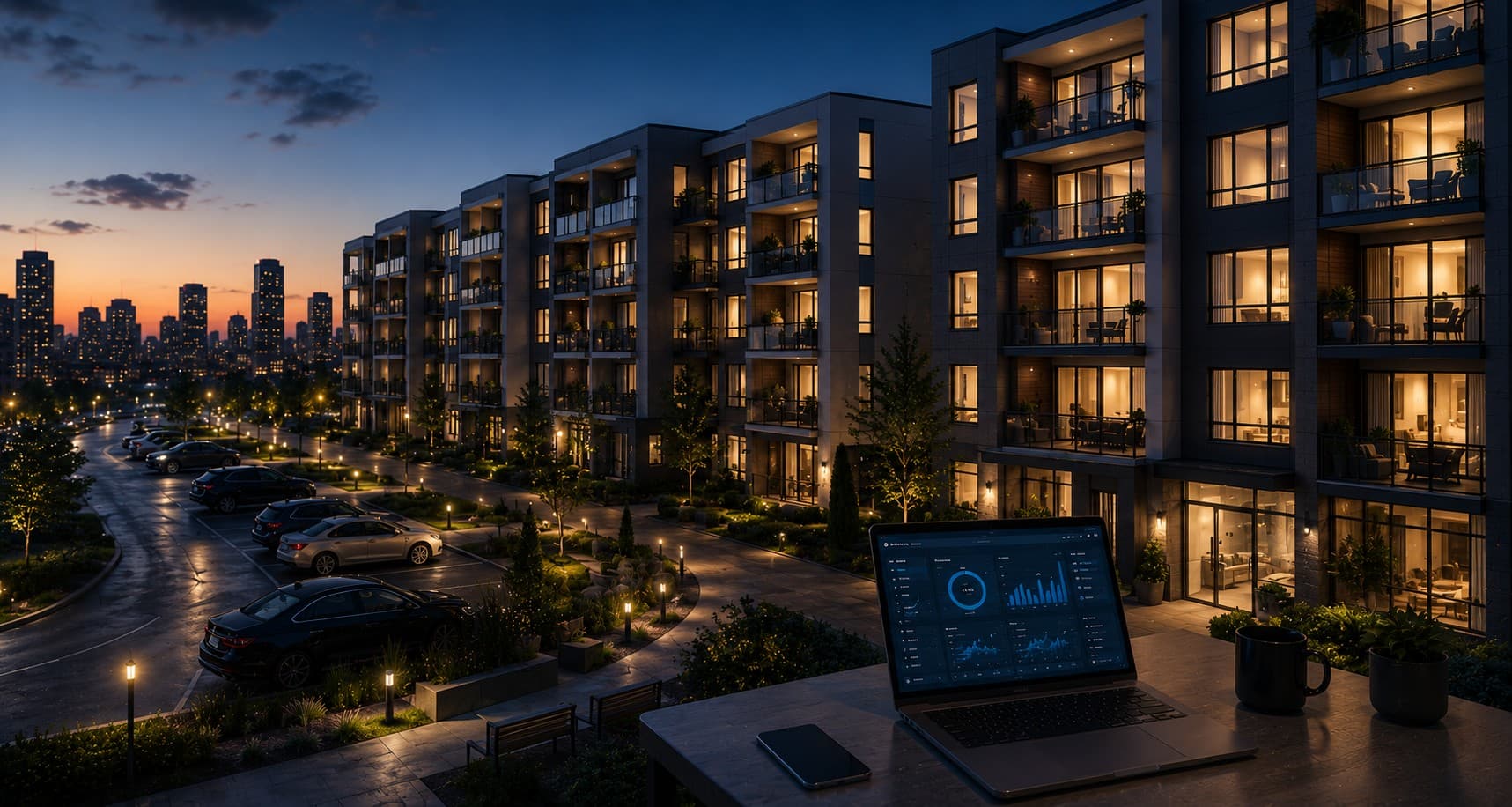
Multi-Dwelling Units
MDU IT solutions UK — private networks at residential scale
Multi-dwelling developments demand IT infrastructure that is fundamentally different from hotels or offices. Per-unit private VLAN, bandwidth for 2,000 concurrent residents, smart-building integration across multiple vendors — Pacific Infotech Group designs and delivers it, from RIBA Stage 2 through to long-term managed support.
Flagship MDU deployment
The Collective Old Oak — 546 apartments, 114 APs, 2,000+ residents
One of Europe’s largest co-living developments. We designed and deployed the full network infrastructure: 114 access points across 546 apartments, serving over 2,000 residents on a single managed network with per-unit VLAN isolation, communal-area high-density coverage and a resident-facing support setup that keeps the building management team out of the IT queue.
546
apartments
114
access points
2,000+
residents
Operational realities
What MDU operators actually need from IT
MDU IT is not scaled-up office IT or simplified hotel IT. It is a distinct discipline with different constraints, different users and different failure modes.
Per-unit private VLAN — not optional
In a hotel, transient guests share a network without privacy concerns. In an MDU, residents live there — they expect network isolation as standard. A resident in unit 204 must not be able to see traffic from unit 312. That requires per-unit VLAN segmentation on every access point, properly enforced at the switching layer. It is the single most important technical difference between MDU Wi-Fi and hotel Wi-Fi.
Bandwidth at residential scale
A 500-unit MDU development can have 1,000 to 2,000 residents simultaneously streaming, gaming and working from home. That load cannot be served from a single small fibre tail. Network design must account for concurrent usage, peak-hour contention and per-unit fair-use policies. The infrastructure that works for a 200-room hotel will not scale to a 500-unit residential block without a complete redesign.
Smart-building integration
MDU developments increasingly integrate door access, lift control, EV charging, parcel lockers and building management systems onto a shared IP network. Each system has a vendor, a commissioning engineer and a support contract — and all of them interface with the same network infrastructure you are responsible for. Your IT partner needs to understand those integrations and hold the overall network design accountable across all of them.
Resident-facing helpdesk and self-service
Residents expect to log Wi-Fi issues via an app or portal, not phone a number and wait. A well-designed MDU IT setup includes a resident-facing ticketing portal, password reset, and network troubleshooting flows that resolve most issues without an engineer visit. Without it, every connectivity complaint lands on the building management team.
Long asset lifecycle — design it right first time
Residents stay months or years. If the cabling is wrong, if the AP density is insufficient, or if the switching architecture doesn't support VLAN per unit, there's no easy fix without a full reinstatement. MDU IT infrastructure decisions made at RIBA Stage 3 shape what's possible for the next 15 years. Getting the design right from the start is considerably cheaper than rectifying it after residents move in.
Our services for MDU
MDU IT solutions — the full service stack
Scoped for residential scale — from pre-construction design through long-term managed support once residents are in.
Wi-Fi Solutions→
Per-unit private VLAN on shared infrastructure — 1,000+ residents, no cross-contamination.
IT Infrastructure & Networks→
Core switching, structured cabling and riser design for multi-floor MDU buildings.
CCTV Solutions→
IP CCTV across lobbies, car parks, communal corridors, plant rooms and perimeter.
Managed IT Support→
Remote-first managed support with a resident-facing helpdesk portal and ticket system.
Cyber Security→
Network segmentation, threat monitoring and GDPR-compliant resident data handling.
VoIP & Telephony→
Intercom, door-entry telephony and back-office PBX for management teams.
Cloud & Microsoft 365→
M365 and cloud infrastructure for the management and operations team.
Disaster Recovery & Backup→
Backup and recovery for network configuration, resident records and access-control data.
New Build IT Projects→
End-to-end IT from RIBA Stage 2 — ideal for new MDU developments.
IT Gap Analysis→
Free audit of your MDU IT estate against best practice for your building size.
Vertical differences
MDU versus hotels and BTR — why the IT is different
We work across all residential and hospitality verticals. The differences in IT requirements are real and material — not just a matter of scale.
MDU
Long-stay, resident-private, bandwidth-heavy
- ✓Per-unit private VLAN is a resident expectation, not a premium feature
- ✓1,000+ concurrent users — bandwidth design is fundamentally different
- ✓Smart-building integration across multiple vendors at commissioning
- ✓No PMS, no F&B — resident portal and building systems are the core
- ✓Infrastructure decisions at RIBA Stage 3 last 15+ years
Hotels
Transient guests, PMS-driven, 24×7 front desk
- —Overnight guests share a network — private VLAN per room not required
- —PMS is the operational core — IPTV, telephony and billing integrate to it
- —PCI-DSS scope from payment terminals adds compliance complexity
- —F&B IT (POS, kitchen display) — not present in MDU developments
Build-to-Rent
Purpose-built rental with amenity-heavy common areas
- —Residents stay 1–3 years — similar VLAN requirements to MDU
- —Amenity spaces (gym, co-working, lounge) add Wi-Fi density challenge
- —Property-tech integration (Yardi, MRI, Salto) is standard expectation
- —IT typically scoped from RIBA Stage 2 — new-build by definition
Start here
Free MDU IT Gap Analysis
A senior engineer reviews your building’s IT estate — or your new-build specification — against best practice for your unit count, resident density and smart-building requirements. No obligation, no sales pitch.
Same-business-day response from a senior engineer.