
Hotel IT Infrastructure
Hotel network infrastructure designed for operational resilience.
Core switching, VLAN architecture, HA firewalls, fibre backbone and segmentation — for hotels, resorts, MDUs and co-living developments where the network has to survive whatever the building throws at it.
The challenge
Hotel networks carry everything at once.
Modern hospitality infrastructure is significantly more complex than office networking. When the network becomes unstable, the operational pressure spreads across the entire property almost immediately.
Guest Wi-Fi
600 guests at breakfast simultaneously. RSSI ≥ −67 dBm across every room.
IPTV multicast
Multicast traffic on dedicated VLANs — can consume significant bandwidth if not engineered correctly.
PMS platforms
Opera, MEWS and others require reliable, low-latency LAN access for front-desk operations.
VoIP telephony
QoS policies and voice VLANs prevent call quality degradation during peak Wi-Fi load.
Conference environments
Isolated conference VLANs prevent bandwidth contention with hotel operational traffic.
CCTV & access control
Camera streams, door entry and key systems require isolated, reliable infrastructure.
The compounding problem
A temporary outage in a corporate office pauses productivity. In hospitality, the same outage hits check-in, payments, guest Wi-Fi, IPTV, conference events and room access simultaneously — while guests are in the building and operations cannot stop.
Property types
Scaled for the property, not the vendor catalogue.
From boutique hotels with a single comms room to large multi-building resorts and MDU developments with carrier-grade requirements.
- Single firewall
- Guest/staff VLAN separation
- Managed PoE switching
- Wi-Fi & CCTV integration
- Fibre internet failover
- HA firewall pairs
- Stacked core switches
- Multi-comms-room fibre
- Conference-network segregation
- Dual ISP failover
- Private VLAN architecture
- Ruckus DPSK
- Resident isolation
- Multicast control
- Carrier-grade density
What we deliver
Every layer of the hospitality network stack.
Core switching architecture
The switching layer sits underneath every system in the property. We deploy stacked switching, fibre aggregation, redundant uplinks, Layer 3 routing and PoE infrastructure using HPE Aruba, Cisco, Ruckus ICX, Dell and Fortinet — selected for the operational requirement, not vendor preference.
Firewall & internet edge
Hospitality internet infrastructure needs more than a single firewall. We design HA firewall pairs, dual-WAN failover, site-to-site VPNs, guest-network isolation, traffic shaping and bandwidth prioritisation across enterprise platforms.
Fibre backbone & structured cabling
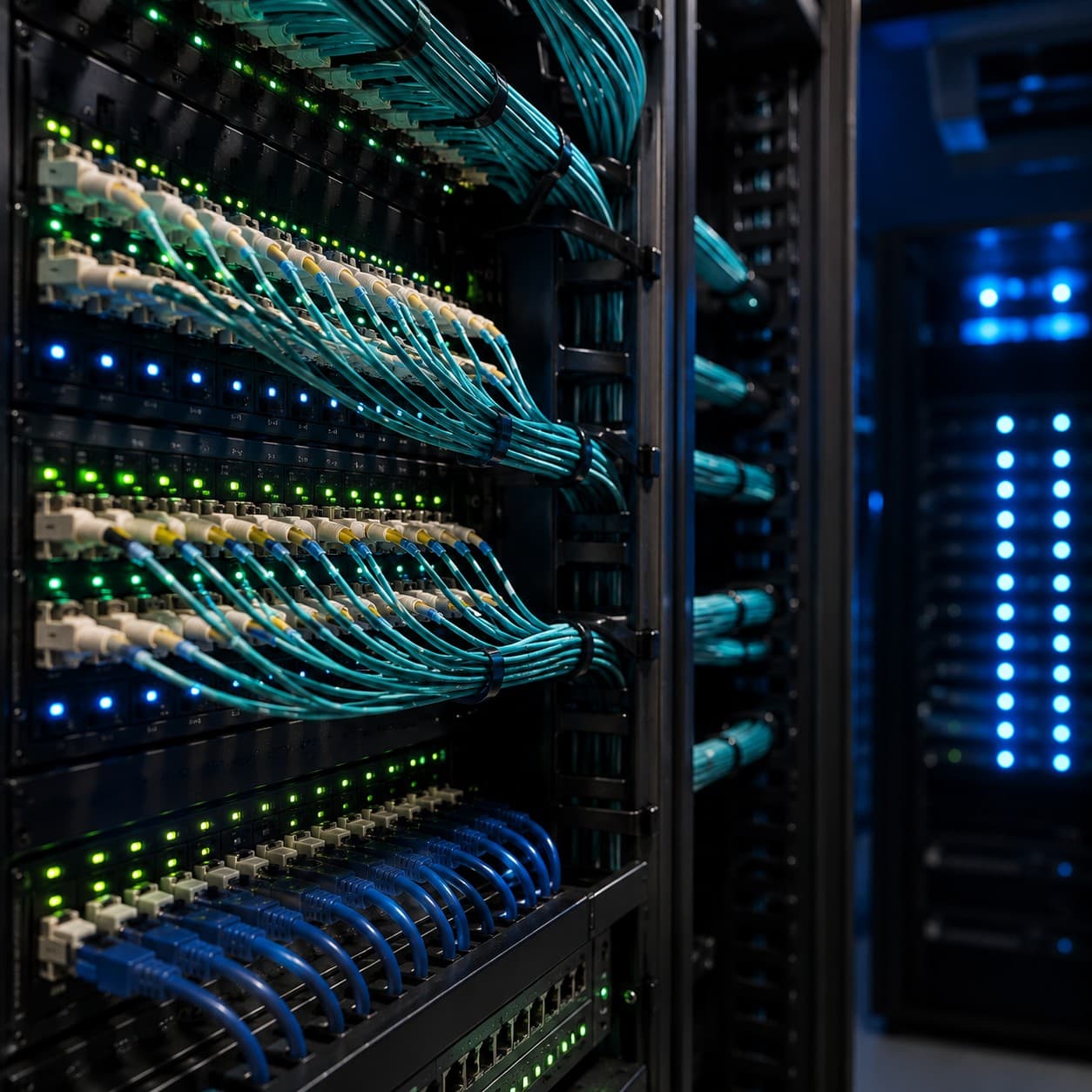
Many hospitality outages begin physically. Poor fibre planning, no redundancy, improper riser design — we design star-topology fibre distribution, comms-room interconnectivity, rack layouts and uplink resilience for multi-building estates and resorts.
VLAN management & segmentation
Flat hotel networks are one of the most common problems we inherit — guest, PMS, CCTV, VoIP and staff devices all on the same LAN. We design segmented networks that isolate traffic, limit blast radius and make troubleshooting dramatically faster.
Private VLANs for MDUs & co-living
MDUs require apartment-level isolation underneath a seamless guest experience. We deploy private VLAN environments, Ruckus DPSK, resident isolation and scalable multicast handling — carrier-grade architecture that scales as the development grows.
Monitoring & ongoing management
Infrastructure management doesn't end at deployment. We provide network monitoring, bandwidth analysis, firewall management, firmware lifecycle management, VPN management, documentation and operational troubleshooting as part of managed support.
Infrastructure debt
The infrastructure problems we most commonly inherit.
Most major hospitality outages are not caused by dramatic hardware failure. They are accumulated infrastructure debt quietly surfacing during occupancy.
Unmanaged switches hidden above ceilings with no documentation
Ageing firewalls running unsupported firmware — patches months behind
Guest and operational traffic mixed on the same flat LAN
No failover internet — single circuit with no backup
Conference traffic sharing IPTV uplinks and causing multicast issues
Overloaded core switches during occupancy peaks
Fibre backbone with no redundancy between comms rooms
"Temporary" network workarounds still active years after installation
Wi-Fi vendors installed without proper switching upgrades underneath
No network documentation — nobody knows what connects to what
Where we work
Hospitality environments where the network genuinely matters.
Hotels, resorts, serviced apartments, co-living developments and conference-led hospitality estates — including multi-property groups and MDU environments across the UK and EU.
Hospitality technology only feels stable when the infrastructure underneath it is stable. Guests see Wi-Fi, IPTV and room systems. Underneath sits switching, firewalls, VLANs, fibre and routing. When that layer is engineered properly, the rest of the property becomes dramatically easier to operate.
HA
Firewall pairs
No single point of failure at the edge.
L3
Core switching
Routing and VLAN management at the core.
DPSK
MDU segmentation
Apartment-level isolation at scale.
24×7
Infrastructure monitoring
Alerts before guests notice.
FAQ
Hotel IT infrastructure — questions we get asked.
Both. We regularly inherit existing hospitality environments and stabilise or modernise them. Many properties don't need full replacement — they need structured improvements to the existing estate.
Yes. Most hospitality estates evolve over years and contain multiple vendors across switching, Wi-Fi and security. We're comfortable navigating and improving mixed environments without forcing wholesale replacement.
Yes — flat hospitality networks create operational, performance and security problems quickly. Guest devices, PMS, CCTV and VoIP on the same LAN means a single problem affects everything simultaneously.
Commonly FortiGate, Palo Alto, SonicWall, Cisco and Sophos — selected based on the property's occupancy, bandwidth, operational complexity and support requirements rather than brand preference.
Yes. These are among the most technically demanding hospitality networking environments we work with. Residents behave very differently from transient guests — private VLANs and DPSK solutions are typically required.
Yes. Deployment, monitoring, firmware lifecycle management, documentation and operational support can all be provided as part of a managed infrastructure engagement.
Want an honest view of the infrastructure?
A senior hospitality engineer visits the property, reviews the network architecture and gives you a written summary of where the risks and improvement opportunities genuinely sit.
Book a free Gap Analysis →