
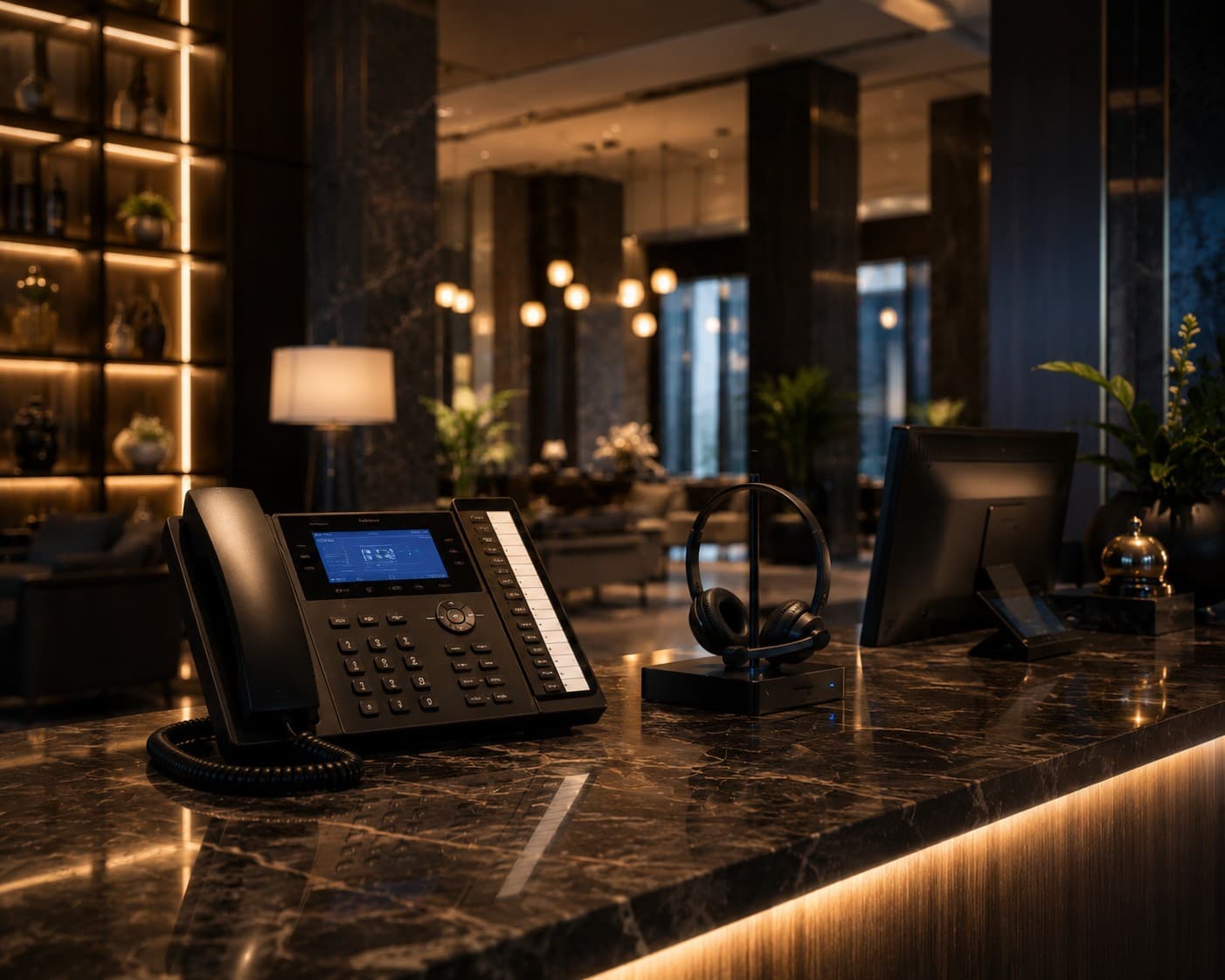
Hotel VoIP & Telephony
Hotel VoIP & telephone systems designed around how hotels actually operate.
3CX, Mitel, Microsoft Teams Phone and Cisco UCM. SIP migration, PSTN switch-off planning, TigerTMS PMS integration, guest-room phones and multi-site hospitality communication — across the UK and EU.
The UK analogue telephone network is being retired. Deadline: January 2027.
Hotels still running ISDN or legacy PBX need to migrate to SIP or hosted VoIP before the switch-off — or face a hard telephony failure. The earlier the migration, the lower the operational risk.
Operational infrastructure
Hotel telephony is not just about making calls.
Telephony inside hospitality still matters far more than many people assume. Traditional PBX systems are being replaced by VoIP, SIP and cloud communications — but the operational dependency on telephony has not decreased.
When telephony fails inside a hotel, the operational impact becomes visible very quickly. That is why hospitality communication systems need resilience, proper design and integration with the wider infrastructure — not just a cloud migration to tick a box.
Hospitality telephony should feel invisible. Guests simply expect reception to answer, room service to respond and operational teams to stay connected.
Guest experience
Room-to-reception calls, room service, concierge and wake-up calls — all telephony-dependent.
Operational responsiveness
Housekeeping, maintenance and conference support coordination runs on internal extensions.
Emergency communication
Guest safety calling requirements mean telephony cannot simply go offline during an outage.
Front-desk efficiency
Hunt groups, call routing and PMS integration affect how quickly reception can serve guests.
Conference coordination
Conference suites need dedicated telephony capacity separate from guest-room operations.
Operational continuity
A hotel telephony failure at 3am is not a morning problem. Guests and operations both feel it immediately.
Platforms we deploy
Platform choice follows the requirement — not vendor habit.
We deploy and support across the main hospitality telephony ecosystems, with hospitality-grade SIP handsets from Yealink, Snom and Fanvil selected for durability, aesthetics and PMS-integration requirements.
3CX
Boutique & mid-marketFlexible hosted or on-premise PBX popular across UK boutique and mid-market hotels. Cost-effective deployment, browser-based admin, strong remote management and softphone support for back-office staff.
- Cloud or on-premise
- Browser-based admin
- Mobile softphone
- SIP trunk agnostic
Mitel
Luxury & large propertiesMiVoice and MiContact Center have long-standing hospitality presence, particularly across larger and luxury properties with established Mitel estates and complex front-desk workflows.
- MiVoice Business
- MiContact Center
- Hospitality module
- Legacy estate support
Microsoft Teams Phone
Back-office & multi-siteIncreasingly used for hotel back-office, sales and remote workers as part of a wider Microsoft 365 deployment. Complements rather than replaces guest-facing telephony in most hospitality environments.
- M365 integration
- Direct Routing
- Softphone & desk phone
- Multi-site groups
Cisco Unified Communications
Large Cisco estatesTypical choice for large hospitality groups already standardised on Cisco infrastructure — UCM integrates cleanly with existing Cisco switching and security architecture.
- UCM platform
- Cisco IP phones
- CUCM clustering
- Cisco BE6000
PSTN migration
How we migrate hotels from ISDN and legacy PBX without disrupting live occupancy.
Hospitality telephony migrations cannot disrupt live occupancy. Every cutover is staged so that reception, guest communication and emergency calling remain stable throughout.
Audit existing infrastructure
Catalogue every analogue dependency: fax lines, lift alarms, door entry, DECT, guest-room phones
SIP carrier selection
Select UK SIP trunk provider with hospitality-grade SLAs and geographic number porting
PBX migration planning
Hosted, on-premise or hybrid — decided by resilience needs, not cloud trends
Network preparation
QoS policies, voice VLANs, PoE switching and WAN failover configured before cutover
Staged rollout
Back-office first, guest floors second — hotel stays operational throughout migration
PMS & TigerTMS integration
Room-extension mapping, call accounting, wake-up calls and folio chargeback restored
Testing & sign-off
Emergency calling, roaming, hunt groups and PMS sync verified before full cutover
PMS integration via TigerTMS
TigerTMS (part of the Uniguest group) sits between the PBX and Opera or MEWS — handling call accounting, voicemail, room-status updates, wake-up call automation and folio chargeback. Standard across most UK hotel estates and something we configure and support directly.
Infrastructure-first
Most hotel VoIP problems are network problems underneath.
VoIP only works properly when switching, QoS, VLANs, WAN resilience and firewall policies are engineered correctly underneath. The PBX platform is rarely the root cause of call quality issues.
QoS policies
Voice traffic marked and prioritised at the switch layer — prevents audio degradation when guest Wi-Fi peaks.
Voice VLANs
Telephony segmented from guest, staff and operational traffic — cleaner call quality and better security posture.
PoE switching
IP handsets and DECT base stations need proper PoE budgeting — underpowered switches cause random handset resets.
WAN resilience
Dual internet carriers with failover keeps telephony live when the primary circuit fails — critical for 24×7 operations.
Firewall SIP policies
SIP ALG causes more hotel VoIP problems than any other single factor. Must be disabled and SIP handled correctly at the edge.
Survivability
Cloud telephony with no local survivability means calls fail during internet outages — unacceptable in hotel operations.
SIP ALG — the single most common cause of hotel VoIP failure
SIP Application Layer Gateway is enabled by default on most consumer and SME-grade firewalls. It corrupts SIP signalling attempting to “help”. The first fix in almost every hotel VoIP remediation we perform is disabling SIP ALG and configuring the firewall correctly for SIP passthrough.
What we inherit
Most hospitality telephony problems are infrastructure and planning problems underneath.
We see the same recurring patterns across hotels of every size. Most of them could have been avoided with proper infrastructure design from the start.
That matters more as the PSTN switch-off deadline approaches — hotels with undocumented analogue dependencies and ageing ISDN estates are at the highest operational risk.
Common telephony problems we inherit
- Ageing PBX hardware on unsupported firmware
- Legacy ISDN lines still active with no migration plan
- Reception hunt groups misconfigured — calls going to voicemail at busy periods
- No QoS configured — VoIP calls dropping during Wi-Fi peaks
- Flat networks affecting call quality across guest-room traffic
- Analogue dependencies nobody documented when the last engineer left
- Conference calls failing during occupancy peaks
- "Temporary" phone workarounds still running years later
- Telephony managed completely separately from network infrastructure
- No failover — single internet circuit with no telephony backup
Integrated services
Telephony connects to the wider infrastructure:
FAQ
Hotel VoIP & telephony questions
BT is retiring the UK's analogue PSTN and ISDN network. The final switch-off deadline is January 2027. Hotels still running legacy PBX systems on ISDN lines need to migrate to SIP or hosted VoIP before that date — or risk a hard telephony failure. The earlier the migration, the lower the operational risk.
It depends on the property. Cloud telephony offers simpler management and easier scaling, but requires stable internet resilience and local survivability planning. On-premise PBX keeps calls working during internet outages. Many hotels use a hybrid approach. We recommend based on the building's resilience requirements — not on what's trending.
Often yes, using analogue telephone adapters (ATAs) at the PBX layer. This avoids replacing every room phone in one hit. Longer term, IP handsets from Yealink, Snom or Fanvil are more reliable and easier to manage remotely.
Yes. Hotel telephony integrates with PMS through middleware platforms like TigerTMS — handling room-extension mapping, call accounting, folio chargeback and wake-up call automation. This is standard for UK hotel estates and something we configure and support directly.
Almost always a network problem underneath. The most common culprits are SIP ALG enabled on the firewall, missing QoS policies, voice traffic sharing a VLAN with guest Wi-Fi, or insufficient WAN bandwidth during peaks. The PBX platform itself is rarely the root cause.
Yes. Centralised hosted PBX with inter-site dialling, shared reception workflows and standardised numbering plans are increasingly common across UK hospitality groups. Cloud-hosted 3CX or Mitel MiCloud is the most common architecture we deploy for this use case.
PSTN switch-off — act before January 2027
Not sure whether your hotel telephony is ready for the switch-off?
Book a free 60-minute IT Gap Analysis. A senior hospitality engineer reviews the current telephony environment, documents every analogue dependency, and gives you an honest migration plan — before the deadline forces your hand.
No obligation · No telecom sales jargon · No slide deck.