
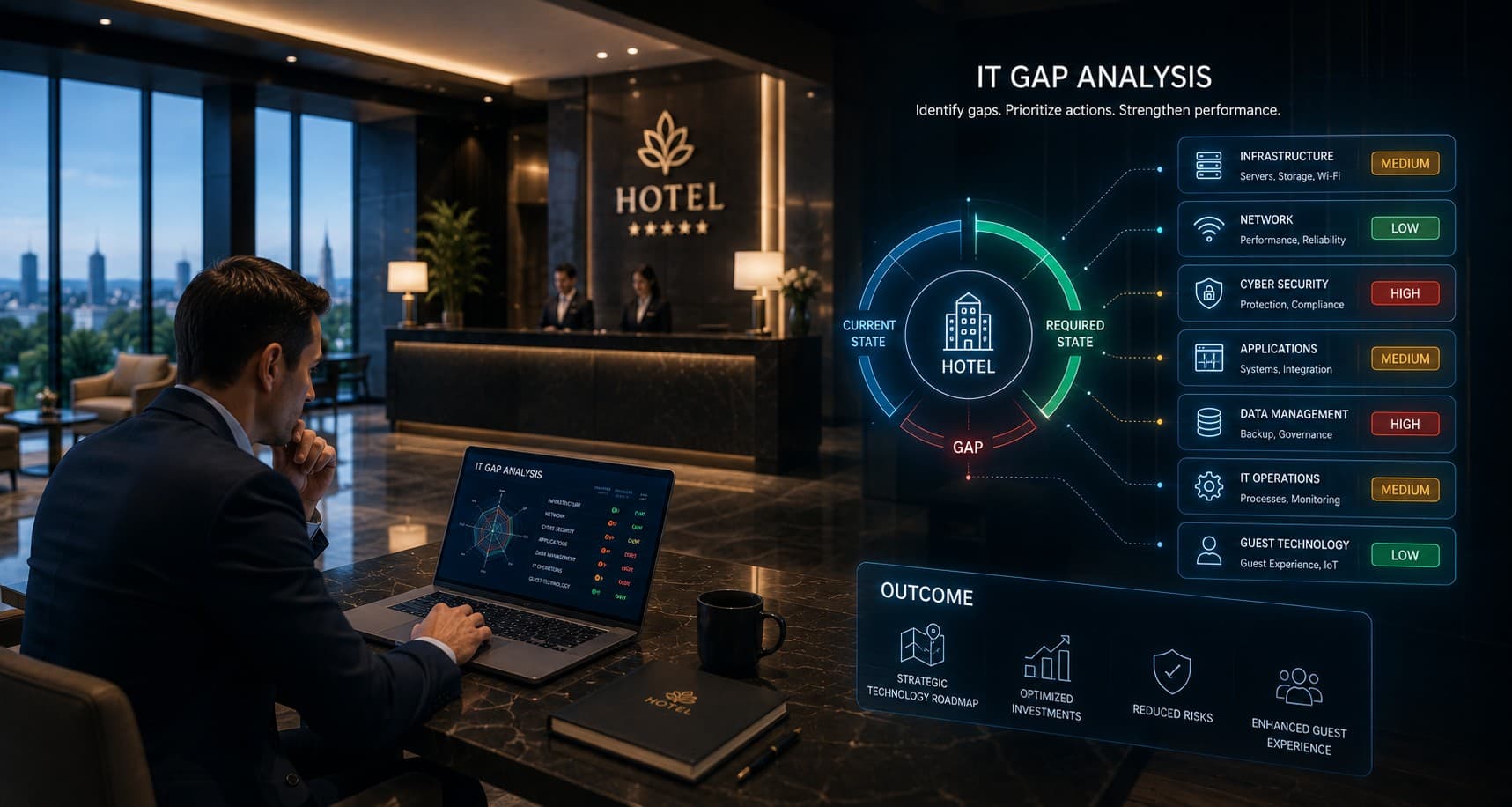
Hotel IT Gap Analysis
A real hospitality technology conversation, onsite at your property. One of our senior engineers sits down with your leadership team — no software installed, no sales script, written summary included.
- Senior hospitality engineer, not a salesperson
- No scanning tools or software installed
- No disruption to your current IT provider
- Short written summary afterwards
What it is
Not a formal audit. A senior-level hospitality technology conversation.
Most hotel IT issues reveal themselves very quickly once you sit down with the right person. Sometimes it is the IT Manager explaining recurring Wi-Fi complaints. Sometimes it is the CFO frustrated by supplier costs. Sometimes it is the GM saying:
"Nothing major is broken, but the technology constantly feels fragile."
That is exactly why we offer the Gap Analysis. One of our senior hospitality engineers visits the property for a focused 60-minute discussion — not a technical inspection. The value comes from the conversation itself.
What the session covers
- What is working well
- What is becoming operationally painful
- What looks non-standard or fragile
- Where the risks probably sit
- Where the opportunities for improvement are
- Optional: walkthrough of comms room, guest Wi-Fi areas, conference spaces
What you receive afterwards
A concise written summary — usually a few pages — covering key observations, concerns, non-standard areas, and prioritised next steps. Practical, not a 200-page consulting document.
Who it’s for
The conversation adapts to who we’re meeting.
Technical and operational focus
Usually a peer-to-peer engineering conversation covering:
- Recurring support issues and ticket patterns
- Wi-Fi complaints and RF performance
- PMS integrations and frustrations
- Cyber-security concerns and posture
- Ageing infrastructure and refresh cycles
- Supplier responsiveness and coordination
- Conference and event challenges
- Future upgrade plans and timelines
Operational and strategic focus
Non-technical leadership often understands pain points very clearly — just not technically:
- Operational disruption and guest complaints
- Supplier friction and blame cycles
- IT budgeting and cost visibility
- Cyber-security risk and insurance exposure
- Refurbishment or expansion plans
- Whether the technology still supports the business
- Multi-property consistency
- Technology roadmap ownership
Topics discussed
Every property is different. These areas come up most.
Some hotels arrive with a very specific issue. Others simply want an experienced hospitality engineer to give them an honest second opinion. Both are completely fine.
A few recurring things we commonly hear across properties:
"The Wi-Fi mostly works — until the ballroom fills up."
"Our suppliers always blame each other during outages."
"We're not sure whether the backups actually work."
"Nobody really owns the technology roadmap."
"Cyber security worries us, but we don't know where to start."
What makes it different
Designed specifically for hospitality environments.
Hospitality-specific understanding
Hotels are operational environments, not office buildings. A hospitality IT conversation includes guest impact, occupancy pressure, conference events, front-of-house visibility, supplier coordination and soft-open realities — not just technical infrastructure.
No invasive tooling
Nothing is installed. No scanning software, monitoring agents, data collectors or remote-access tools. The goal is understanding the environment — not disrupting it or creating tension with your incumbent supplier.
Practical and conversational
This is designed to feel like a useful discussion between practitioners — not a compliance inspection. The most valuable information often comes from what the duty manager casually mentions, what frustrates the front desk most, and where the IT team seems uncomfortable.
Why hotels book it
Three situations that typically start the conversation.
Independent second opinion
Sometimes properties simply want confirmation that things are healthy, suppliers are advising correctly, infrastructure decisions make sense, and nothing obvious is being missed. That independent perspective has value.
Planning future projects
The Gap Analysis is often used before refurbishments, Wi-Fi refreshes, PMS migrations, cyber-security projects, managed support transitions, new-build planning or hospitality acquisitions. Early conversations prevent expensive mistakes later.
Understanding operational risk
Technology issues in hotels rarely appear gradually. Everything feels 'mostly fine' until the PMS fails at check-in, conference Wi-Fi collapses, ransomware appears, or IPTV stops across a wing. The Gap Analysis identifies where those risks may already sit quietly underneath.
What comes next
The Gap Analysis connects naturally into:
FAQ
Questions about the Gap Analysis
Yes. The onsite conversation and the follow-up written summary are provided without obligation or cost. It is how most of our client relationships begin.
No. This is a hospitality technology discussion and operational review — not a formal infrastructure audit, penetration test or compliance assessment. A detailed technical audit would always be a separate engagement if required later.
Nothing is installed during the Gap Analysis. No scanning agents, data collectors or remote-access tools. The session is entirely conversational and observational.
Whoever best understands the operational or strategic side of the property — typically the IT Director, IT Manager, General Manager, CFO, CEO or owner representative. The conversation adapts depending on who we're meeting.
Completely normal. The Gap Analysis is designed as a collaborative second opinion, not a replacement exercise. There is no disruption to your existing support arrangement.
Where useful, yes — observationally and conversationally. We may walk the comms room, server racks, conference spaces or guest-floor Wi-Fi areas. But this remains a guided walkthrough rather than a detailed technical audit.
A concise written summary — usually a few pages rather than a giant consultancy document. It covers key observations, areas of concern, things that appear non-standard, and practical suggestions around priorities and next steps.
Typically within one to two weeks of first contact. We work across London and the wider UK, and travel to the property as part of the service.
Book your session
One conversation. One hour. No obligation.
The reason this works is simple: hospitality technology problems are easier to understand through conversation than through software tools. An experienced engineer sitting onsite with the right stakeholder will uncover more in one hour than a remote audit uncovers in a week.
No software installed · No sales script · Written summary included · London, UK & EU